


Page 25 - Untitled-1
P. 25
About
Chapter 6  Animals

Animal Groups
Animals are one of the basic groups of life on Earth. All animals share a set of
fundamental characteris cs- they move, they feed on other organisms. Some live in
pairs and many animals live in groups. Living in a group can have its advantages. Some
animals, such as lions and wolves, hunt in a group making it easier to catch prey that
may be difficult to catch if they were on their own. Other animals save energy by living
and moving in groups, such as ducks who ride in another duck's slipstream when
migra ng, or some birds which huddle together in winter to avoid losing excessive
heat. Living in a group can also afford some protec on from predators and also makes
it easier for animals to breed.

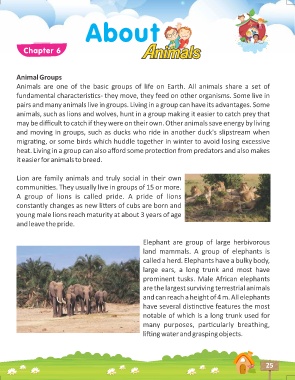
Lion are family animals and truly social in their own
communi es. They usually live in groups of 15 or more.
A group of lions is called pride. A pride of lions
constantly changes as new li ers of cubs are born and
young male lions reach maturity at about 3 years of age
and leave the pride.

                                                   Elephant are group of large herbivorous
                                                   land mammals. A group of elephants is
                                                   called a herd. Elephants have a bulky body,
                                                   large ears, a long trunk and most have
                                                   prominent tusks. Male African elephants
                                                   are the largest surviving terrestrial animals
                                                   and can reach a height of 4 m. All elephants
                                                   have several dis nc ve features the most
                                                   notable of which is a long trunk used for
                                                   many purposes, par cularly breathing,
                                                   li ing water and grasping objects.

                    25

